All articles
Appliance Care15 October 2026
The Hidden Fire Risk in Your Extractor Hood (And How to Deal With It)
Is your kitchen extractor hood working as hard as it should? Beyond the grease and grime, it could be a hidden fire hazard. Discover how Fordwell can help.
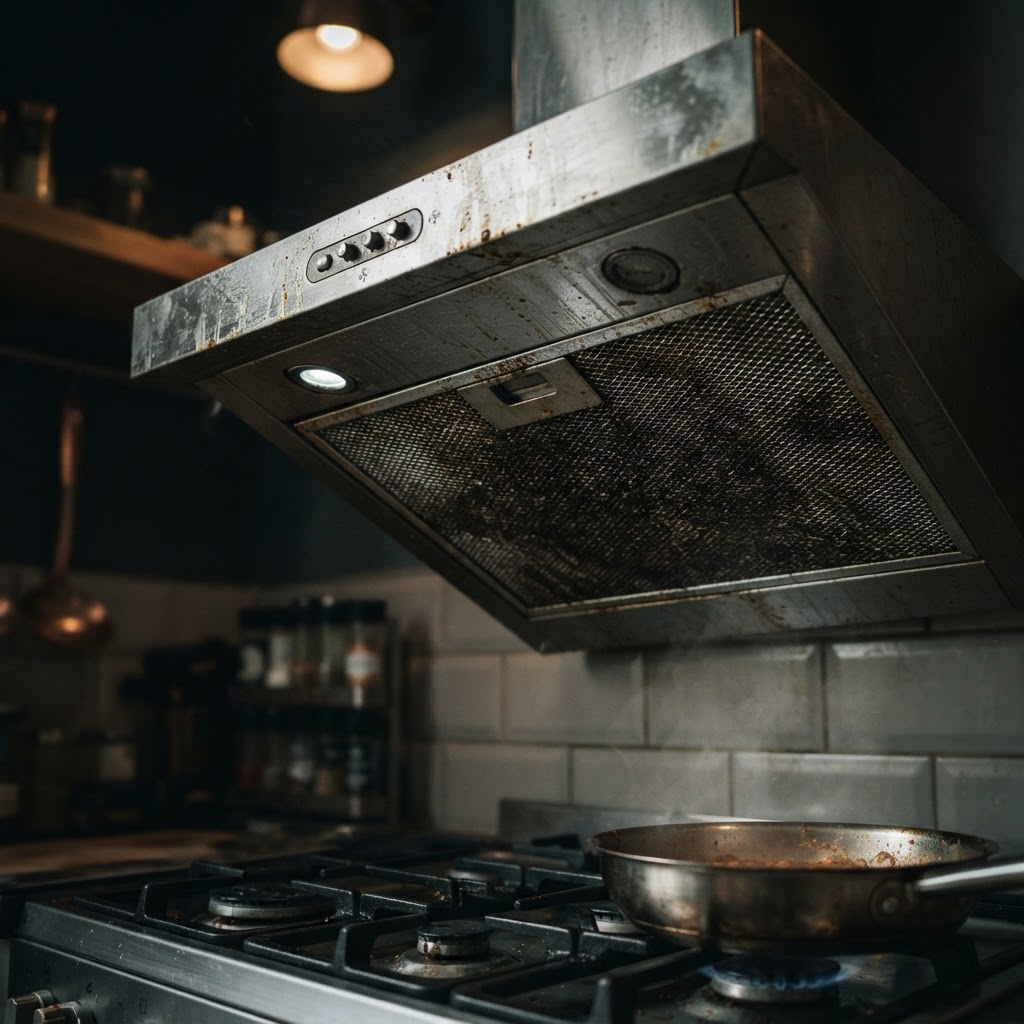
Why Your Extractor Hood Needs More Than Just a Wipe Down. Most of us are diligent about wiping down our kitchen worktops and cleaning the hob after cooking a meal, but there is one crucial appliance that often gets ignored until it stops working efficiently: the extractor hood. It sits silently above our stoves, diligently pulling away steam, odours, and smoke, but it is also busy trapping something far more sinister behind its vents: grease. At Fordwell Oven & Appliance Care, we see the hidden dangers of neglected extractor hoods every day across Kent, Surrey, and the South East. While a bit of surface dust is annoying, a heavy build-up of grease inside your extraction system is a genuine fire safety risk that every homeowner needs to take seriously. ## How Grease Builds Up in Your System. Every time you fry an onion, sear a steak, or roast a chicken, tiny droplets of vaporised fat are released into the air along with the steam. As your extractor fan pulls this air up into the hood, those fat particles cool down and settle on the underside of the filters, inside the ducting, and even on the fan motor housing itself. Over time, these thin layers of grease accumulate and thicken into a sticky, stubborn residue. It is not just the visible filters that suffer; the entire internal system gradually becomes coated. ## The Hidden Fire Risk. Why is this so dangerous? Think of your extractor hood as a magnet for flammable material. If you happen to have a flare-up on your hob—perhaps from an overheated pan or a splash of oil—the flames can be pulled directly into the intake of your extractor hood. If the metal filters, the internal housing, and the fan blades are coated in a thick layer of congealed grease, that fire can ignite in seconds, travelling deep into the ducting where it becomes incredibly difficult to extinguish. This is not just a theoretical risk; grease fires in extractor hoods are a leading cause of kitchen blazes in the UK. ## Warning Signs to Watch For. Your extractor hood will usually try to tell you when it has reached its limit. Keep an eye out for these four signs: 1. Grease dripping: If you see spots of oil appearing on your hob or work surfaces after cooking, the filter is saturated and can no longer trap any more grease. 2. Lingering smells: If the kitchen still smells like last night’s dinner hours after you have finished eating, the airflow is likely restricted by heavy build-up. 3. Reduced suction: Hold a piece of kitchen roll up to the filter while the fan is on. If it does not stick firmly, your system is struggling to pull air through. 4. Noisy fan: If your hood sounds like a jet engine or is rattling, the weight of the grease on the fan blades can cause an imbalance, leading to mechanical strain and excessive noise. ## What a Professional Clean Involves. At Fordwell, we believe cleaning should be thorough without being harmful to your home or the planet. Our professional extractor cleaning process goes far beyond a quick wipe. We start by removing the metal grease filters and submerging them in a specialised, non-caustic, food-safe degreasing solution. This breaks down the carbon and fat without leaving behind harsh chemical odours. We then manually clean the canopy, the internal housing, and the fan blades, ensuring that those hard-to-reach areas where fire-prone grease hides are completely cleared. Because we use eco-friendly products, your kitchen is ready to use the moment we finish—no toxic fumes, just a clean, safe appliance. We are fully insured and DBS-checked, giving you complete peace of mind while we work in your home. ## How Often Should You Clean Your Hood? Frequency depends entirely on your cooking habits. A typical household that uses the hob for light daily cooking should ideally have their extractor professionally cleaned every 6 to 12 months. However, if you are a keen home cook who enjoys high-heat stir-fries, deep frying, or regular roasting, you should consider a professional deep clean every 3 to 6 months. ## Maintenance Tips Between Deep Cleans. While you should leave the deep internal cleaning to the professionals, you can keep your system in better shape by: - Putting metal filters through the dishwasher on a hot cycle once a month. - Wiping the exterior canopy with a degreasing spray immediately after cooking. - Never leaving the hob unattended while in use to minimise unnecessary steam and fat particle production. ## Book Your Professional Clean Today. Don't wait for your extractor hood to become a fire hazard. With prices for professional extractor cleaning starting from just £35, it is a small investment for a significantly safer, cleaner kitchen. We cover Kent, Surrey, East Sussex, South London, Essex, and West Sussex. Ready to get your extractor back to peak performance? Visit our website at fordwellovencleaning.com/booking to secure your appointment today.
Need a professional? We can help.
Save time and get better results — book Fordwell's professional oven and appliance cleaning service today.